Legendary 1943 Copper
Every now and then, a story surfaces that reminds coin collectors why they never stop checking their change. Recently, a collector revealed that he inherited a complete set of Lincoln wheat pennies from his late brother — and hidden inside the collection was a genuine 1943 copper penny.
Yes… that penny.
One of the holy grails of U.S. coin collecting, valued at $200,000 to over $300,000. 🪙🔥
Here’s why this coin is so incredibly rare — and how to know if you might have one, too.
🔎 Why the 1943 Copper Penny Is So Rare
Most people have seen (or even owned) the common gray-colored 1943 steel penny, but very few realize how rare the copper version truly is.
🏭 1. A Wartime Metal Switch
In 1943, the U.S. Mint shifted from copper to zinc-coated steel so copper could be reserved for WWII ammunition, wiring, and military equipment.
Because of this change:
➡️ Nearly all 1943 pennies were struck in steel, not copper.
🔥 2. The Accidental Survivors
A tiny handful of leftover copper planchets from 1942 remained inside the equipment by mistake. These copper blanks were accidentally fed into the presses and struck with the 1943 dies.
Experts estimate fewer than 20 genuine 1943 copper pennies exist across all mints.
📊 3. Current Market Value
Depending on condition and mint mark, authentic 1943 copper cents have sold for:
- $200,000 (lower grade examples)
- $300,000+ (high-grade specimens)
- Record prices exceed this when auction bidding heats up
These are life-changing coins — which is why they’re so heavily counterfeited.
✅ How to Authenticate a 1943 Copper Penny
If you believe you’ve found one, you MUST test it carefully. Here are the three essential steps:
1️⃣ Weigh the Coin (Most Important Test) ⚖️
- Copper penny weight: ~3.1 grams
- Steel penny weight: ~2.7 grams
A big weight difference — and a strong clue.
2️⃣ Magnet Test 🧲
- Real copper penny: ❌ Will NOT stick to a magnet
- Steel 1943 penny: ✅ Will strongly stick
If your “copper” penny sticks to a magnet, it’s copper-plated steel — a common fake.
3️⃣ Examine the Date Carefully 🔍
Authentic coins show:
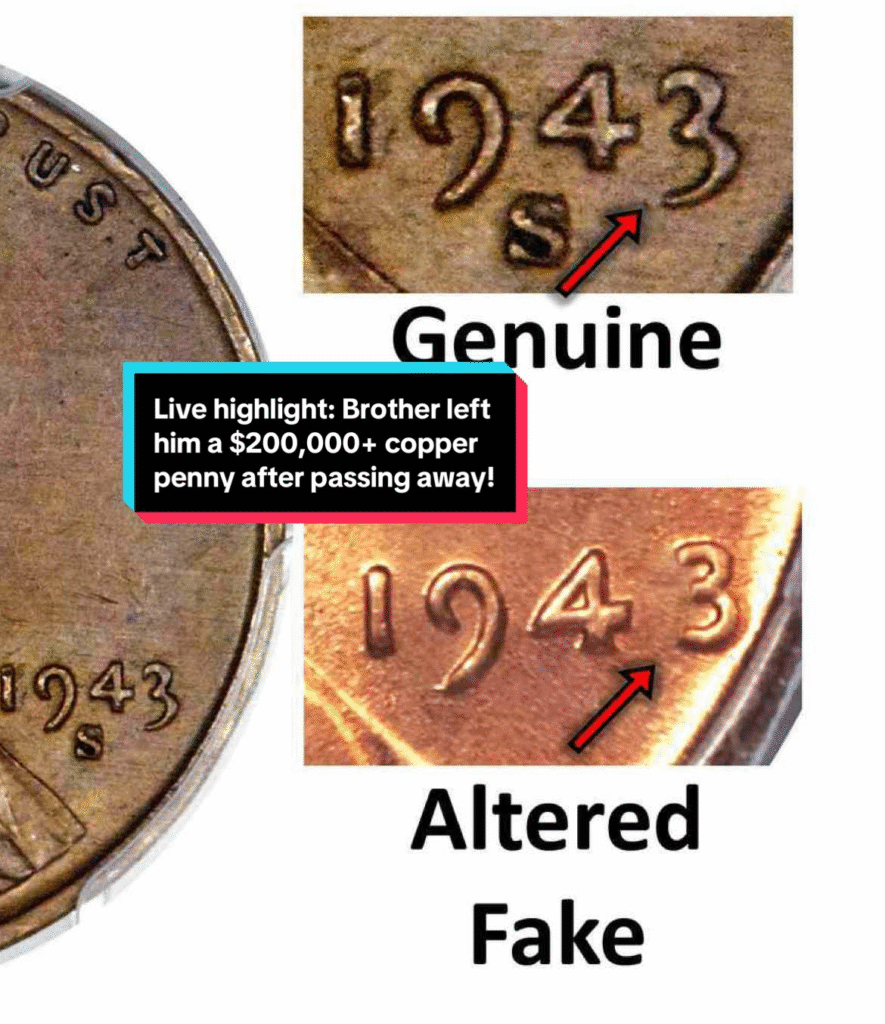
- The “3” in 1943 curves slightly under the “4.”
- The shape and spacing of the numbers match normal 1943 die characteristics.
Most counterfeits are actually altered 1948 copper pennies, where the bottom of the “8” is filed to look like a “3.”
Look closely — the editing is often crude.
⚠️ Beware of Counterfeits
Because of its enormous value, the 1943 copper penny is one of the most counterfeited coins in U.S. history.
Common fakes include:
- Altered 1948 copper cents
- Copper-plated 1943 steel pennies
- Cheap cast imitations from overseas
Even experienced collectors have been fooled.
👉 The ONLY way to know for sure is to submit the coin to a professional grading service such as PCGS or NGC.
Their authentication guarantees the coin’s legitimacy and unlocks its true market value.
🎯 Final Thoughts
The 1943 copper penny is more than a rare collectible — it’s a legendary piece of American history. With values stretching into the hundreds of thousands, this is a coin that can change someone’s life overnight.
If you have old penny collections, estate finds, or inherited wheat cents…
👉 Always check the 1943 penny.
You never know what treasure might be hiding in a dusty jar or forgotten album.


Leave a Reply