Among modern U.S. coins, few errors are as mysterious—or as valuable—as the 1975 No “S” Proof Dime. At first glance, it looks like an ordinary proof Roosevelt dime. But one missing letter has transformed this coin into a $450,000 numismatic legend 🪙💰.
Let’s break down why this coin is so rare, how to identify one, and what to do if you believe you’ve found it.
🧠 Step 1: What Is a Proof Coin—and Why the “S” Mint Mark Matters
Proof coins are not made for everyday spending. They are struck specifically for collectors using:
✨ Highly polished dies
✨ Specially prepared planchets
✨ Multiple strikes for sharp detail
Since 1968, nearly all U.S. proof coins have been produced at the San Francisco Mint, identified by an “S” mint mark on the front of the coin.
That’s where this story takes an extraordinary turn.
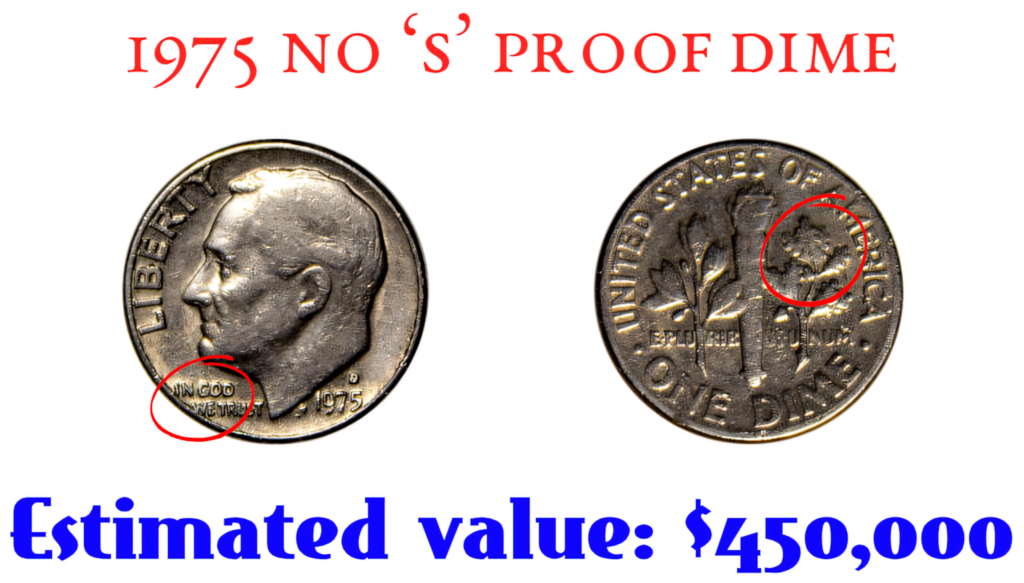
🔍 Step 2: What Makes the 1975 No “S” Proof Dime Unique
The value of this coin comes from what’s missing, not what’s added.
➤ Obverse (Front)
- 🧔 Portrait of Franklin D. Roosevelt facing left
- 📅 Clear date: 1975
- ❌ No “S” mint mark above the date (the space is completely blank)
- 💎 Deep mirror-like proof fields with frosted details
➤ Reverse (Back)
- Torch flanked by olive and oak branches
- Normal design with no visible errors
⚠️ Important: Regular 1975 dimes without an “S” are common and worth face value. Only proof coins qualify.
💵 Step 3: Why This Dime Is Worth Up to $450,000
Yes—the price is real. Verified examples have sold for as much as $450,000 at auction 😲.
Here’s why collectors pay such extreme premiums:
💎 Only Two Known Examples – One of the rarest modern U.S. coins ever discovered
💎 Proof Die Error – A proof die missing the “S” mint mark was mistakenly used
💎 San Francisco Mint Oversight – An error that should never have left the Mint
💎 Elite Collector Demand – Considered a “trophy coin” among top numismatists
🏆 This coin is often ranked among the most important post-1900 mint errors in U.S. history.
🔬 Step 4: The 5-Step Authentication Checklist
Because of its extreme rarity, authentication is mandatory.
Use this checklist before assuming you’ve struck gold:
1️⃣ Proof Finish Check – Mirror fields and frosted details
2️⃣ Mint Mark Verification – No “S” above the date
3️⃣ Die Marker Matching – Specialists compare known die characteristics
4️⃣ Weight & Composition – 2.268 grams, copper-nickel clad
5️⃣ Professional Grading – Must be certified by PCGS or NGC
📌 Without professional certification, the coin has no recognized market value.
💎 Step 5: Why Collectors Call It a Modern Holy Grail
✔️ Fewer than three known specimens
✔️ Missing mint mark on a proof coin (almost unheard of)
✔️ One of the most valuable U.S. coins minted after 1950
✔️ Strong demand from museums and private collectors
✔️ Proven six-figure auction history
This isn’t just a rare coin—it’s a numismatic anomaly.
🏦 Step 6: What to Do If You Think You Have One
If you suspect your dime may be authentic:
- ❌ Do not clean or polish it
- 📷 Take high-resolution photos (front, back, close-ups)
- 🎥 Record a short video under strong lighting
- 📦 Submit it to PCGS or NGC
- 🤝 Consult trusted auction houses or professional dealers
Handling mistakes can destroy tens—or hundreds—of thousands of dollars in value.
💬 Expert Insight
“The 1975 No ‘S’ Proof Dime proves that in numismatics, absence can be more powerful than perfection.”
— Dr. Eleanor Vance, Chief Numismatist, RareCoin Guild
🔐 Final Thoughts
Some legendary coins are created by bold design choices.
Others—like the 1975 No “S” Proof Dime—are born from a single missing letter.
Before you dismiss that shiny proof dime, take a closer look 👀
You might be holding one of the rarest modern U.S. coins ever struck, worth up to $450,000 💎🔥.
Leave a Reply